Friday, August 26, 2011

Trend: mobile OS wars and the advance of open source

Trend: mobile OS wars and the advance of open source
Title: At 20, Linux is invisible, ubiquitous
Comment:

Link: http://www.cnn.com/2011/TECH/gaming.gadgets/08/25/linux.20/index.html?eref=rss_topstories&utm_source=feedburner&utm_medium=feed&utm_campaign=Feed%3A+rss%2Fcnn_topstories+%28RSS%3A+Top+Stories%29&utm_content=Google+Reader

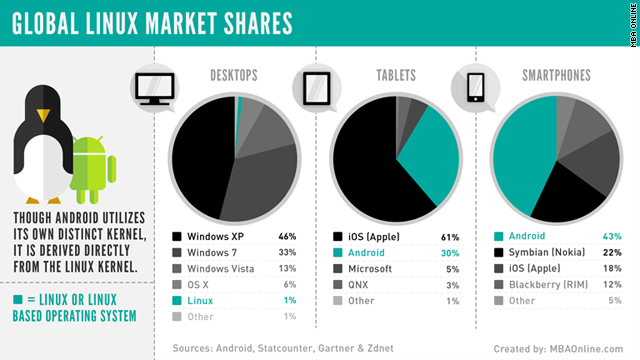
Linux-powered software is growing quickly in emerging industries, as depicted in this CNN infographic from MBAOnline.com.
STORY HIGHLIGHTS
Linux, the free software platform, was conceived 20 years ago
In phones, ATMs, airplane consoles and other machines, Linux is pervasive
Linux, the brand and the desktop operating system, failed to go mainstream
San Francisco (CNN) -- Ross Turk would be happy to explain the tattoo on his arm.
By now, he's used to the penguin being met with bewildered stares. It represents, as he'd tell you, the Linux computing software, not the slightly less obscure character from 1950s cartoons.
"A lot of people see it and they think it's Chilly Willy or something," the West Hollywood, California, man lamented in a recent interview. "The Linux logo is still kind of grass-roots."
When the then-21-year-old Turk got the logo etched into his left bicep in 2000, the penguin seemed poised to become mainstream, then appearing frequently in magazines and on the walls in computer stores. But the software market tumbled with the dot-com bust, and so too did the Linux brand, choked by investors' swift rejection then of the open-source software movement.
Thursday marks 20 years since Linus Torvalds announced on a Web bulletin board that he'd begun working on a free computer operating system. In that message, Torvalds described Linux as "just a hobby, won't be big and professional."
Now, two decades later, that market breakthrough doesn't seem any more attainable. And yet while the Linux name and its penguin mascot failed to go big, the software they embody is more pervasive today than ever.
Linux's skeleton and spirit live on inside another familiar, adorable mascot: the green robot that represents Google's Android operating system. That software, which powers 43% of smartphones worldwide, many tablets and the Google TV set-top boxes, was developed with Linux at its core. Google's Chrome OS for laptops is also based on Linux.
Another mobile system, webOS, sprouted from Linux. Hewlett-Packard says webOS, not the hardware that runs it, is a key asset from its acquisition last year of Palm. This month, HP took steps to discontinue its gadget production arm, but it will keep webOS. HP has discussed licensing the software to other vendors in order to expand webOS's reach, perhaps into computing platforms on appliances and in cars.

Linux creator Linus Torvalds at the LinuxCon 2011 event earlier this month.
Linux is already commonly installed on refrigerators with built-in TVs, car navigation systems, in-flight entertainment systems, public transit displays, ATMs and countless other machines. The Smart TV from Samsung Electronics, which competes with the Google TV, is also based on Linux. Sony previously allowed tinkerers to install versions of Linux onto their PlayStation consoles.
RELATED TOPICS
Linux
Linus Torvalds
Open Source Software
Whether you're aware of it or not, Linux is practically everywhere.
"The fact that you don't have to call it Linux is what makes Linux work," said Jim Zemlin, the executive director of the Linux Foundation. His nonprofit organization was formed to promote Linux development to the industry and sponsors Torvalds' ongoing work on the platform.
14 million lines of code
Linux can exist in so many places because, rather than being owned by one company, thousands of engineers contribute code to the kernel. (The kernel is the brains and sinew of the software, and Torvalds said in an e-mail that it's the aspect of his work that he finds most interesting and that he spends most of his time developing.)
No one can claim ownership of Linux, and everyone is free to use it. The software contains 14 million lines of code and is protected by more than 520,000 patents, according to a Linux Foundation report. Governments like the system's flexibility and decentralized nature.
Technology companies, even giants like Intel and AMD that typically don't publish schematics for their other products, encourage staff to contribute to and implement code from Linux. Google has carried this philosophy into many parts of its business, though not the ones that make the most money. The company did not respond to a request to make an executive available.
Torvalds initially conceived of Linux as a free alternative to Windows. But the collaborative-development, peace-loving ideologies of Linux were no match for the freewheeling, business-savvy, marketing power of Microsoft.
Linux, as a PC platform in the home, showed promise during the boom a decade ago. But it never came to fruition there, even as Apple's Mac has emerged as a more serious player.
Instead, Linux became the bastion of geek morality, the king of the fast-growing server industry where Microsoft and Apple also compete with limited success, and the choice platform for supercomputers in laboratories.
In Microsoft's annual report filed last week to the U.S. Securities and Exchange Commission, the software giant revised its statement on competition to declare the war with Linux over. Microsoft no longer perceives Linux as credible competition to Windows, the change suggests, as ZDNet notes.
A 'sticky' environment
However, Torvalds isn't ready to forfeit the PC.
"I'm definitely not indifferent to the desktop market," Torvalds wrote in an e-mail. "The desktop is a very 'sticky' environment: Users really get attached to their environment."
Several Linux players are still tackling that market, but their efforts amount to only about 1% of desktop usage worldwide. Microsoft controls the lion's share. Microsoft has been very adept at ensuring that Windows comes as the default operating system installed on most new computers.
"Usage isn't what matters; mindshare is what matters," said Jono Bacon, a community manager for Ubuntu, the most popular general-purpose version of Linux. "The biggest challenge we face right now is getting preinstalled on hardware."
You can't even fly on an airplane ... you can't use Facebook, you can't buy a book from Amazon, without running into Linux.
--Alan Clark
SUSE, which makes another Linux desktop platform, and others have been choked by Microsoft's "strong monopoly on the desktop," said Alan Clark, the chariman of the board for the openSUSE Project.
"It's played out differently than I expected, to be honest," Clark said. "We made some progress, but nothing like anybody envisioned."
Yet, SUSE has a comfortable presence in the server market, Clark said.
"Linux is very much pervasive. It's everywhere. You can't even fly on an airplane; ... you can't use Facebook; you can't buy a book from Amazon," Clark said, "without running into Linux."
The cult of Linux
Familiarity with Linux became a crucial skill for budding software engineers and server caretakers as far back as the mid-1990s.
When David Bohnett sought a partner in his new Web venture called GeoCities, resulting in one of the largest Internet business deals ever when it went public and then was acquired by Yahoo for $3.6 billion in 1999, his main criteria was an adeptness with Linux programming, Bohnett said in an interview. John Rezner fit the description and shared in the pair's eventual fortune.
Torvalds, the brain behind Linux, never seemed very interested in fortunes, according to people who know him. The reclusive programming wizard declined through a spokeswoman to be interviewed by phone, though he talked openly through e-mail and appeared on stage last week at LinuxCon in Vancouver, Canada.
There, Torvalds was treated like a celebrity. A lover of reclusive scientists, including Sir Isaac Newton and Albert Einstein, he described the general reactions from Linux fans as "just odd." He wrote: "Sometimes it does get to be a bit overwhelming."
Clark, from SUSE, described a memorable meeting with Torvalds.
"The first time he came to Japan, seriously, it was like a rock star arrived, and I could kind of tell it was really overwhelming for him," Clark said. "He took it in stride."
The Linux faithful are predominantly male, often nerdy, with strong principles about collaborative development that translate to a belief in a less hierarchal, more cooperative society, according to interviews. For example, Ubuntu's Bacon has an Android phone, which uses Google's open-source software, because "the ethical side of me feels like it's the right thing to do," he said. "It's not just a product. It's an ethos."
Apple has tried to define its principles in advertising: artistic, noncorporate and able to "think different." Its brand has been adopted by millions of people.
Meanwhile, Linux has maintained a devout but small following over the last two decades. The Linux software is embedded in many millions of machines, but its ethos and the penguin logo that embodies it remain an underground movement.
To let Turk explain it, because he'd be more than happy to, his tattoo is like a secret handshake, waiting for someone to be able to recognize and reciprocate.
"Every so often, at the gym or something, I'll run into someone who's like, 'That's the Linux tattoo,' and there's a conversation," said Turk, who now works for open-source software maker Talend. "It's always been something that the community feels like it owns. It's almost a little bit anti-establishment. The penguin doesn't stand a chance against the marketing of big firms. But that's great. It's good. It's ours."

Monday, August 22, 2011

Trend: advance of cloud orchestration

Trend: advance of cloud orchestration
Title: Ubuntu joins VMware Cloud Foundry
Comment: interesting, not OpenStack but still open :)

Link: http://www.itweb.co.za/index.php?catid=69&id=46412%3Aubuntu-joins-vmware-cloud-foundry&option=com_content&view=article

Ubuntu joins VMware Cloud Foundry
By Alex Kayle, Senior portals journalist
Johannesburg, 22 Aug 2011

Ubuntu joins VMware Cloud Foundry

VMware is working with Dell and the Ubuntu Linux operating system to spur adoption of its cloud computing software; driving competition against Microsoft, reports Bloomberg.
Dell's services arm will help install VMware's Cloud Foundry programme, while Ubuntu will begin including parts of the software, says Jerry Chen, VMware VP. EnStratus Networks, which lets companies manage cloud computing software, will also support Cloud Foundry.

Cloud Pro says Ubuntu Server 11.10 is set for release in October and will come fully-loaded with Cloud Foundry's desktop application builder, as well as its higher-end server option, enabling users to take advantage of its platform-as-a-service and build their own cloud environments.
Cloud Foundry was developed by VMware and offers a similar service to that of Microsoft's Azure for creating, deploying and scaling applications. However, unlike its more traditional counterpart, the code is open source, allowing other services to work alongside it.

According to The Register, Canonical claims 12 million active Ubuntu desktop users, and VMware boasts that with the Cloud Foundry client on the imminent Oneiric Ocelot, these millions will be only a few commands away from deploying an application on its existing Cloud Foundry service (still in beta).
With the Cloud Foundry server deployment tools bundled as well, Ubuntu users will have the ready option of building their own cloud-based application on the platform.

Trend: the rise of alternate markets

Trend: the rise of alternate markets
Title: Off-exchange trading: Some like it not
Comment: What stirs in the deep?

Link: http://www.economist.com/node/21526387

Off-exchange trading
Some like it not
Institutional investors either love dark pools or hate themTHE words “dark pools” may have a whiff of sulphur about them but they describe a surprisingly simple solution to an old problem for investors: how to buy or sell lots of shares without moving their price. Dark pools are places where anonymous buyers and sellers can trade directly with each other away from normal, “lit” exchanges. Because data are published only once trades are complete, institutional investors such as pension funds are meant to be able to take, or offload, large positions in quoted companies without alerting the wider market.

Dark pools have proliferated over the past five years, winning volume from exchanges (see chart). Broker-dealers including Goldman Sachs have muscled in, setting up their own dark pools to capture transaction fees their clients would otherwise pay to exchanges. Pools owned by broker-dealers now dominate the sector, but as a result many of them have become much less attractive to large investors.

In June only 7% of trades on Goldman Sachs’s Sigma X network were of a size that institutional investors typically make—ie, 10,000 shares or $200,000 in value—according to the most recent data. The average size of a trade was 318 shares, not much higher than the average on exchanges. Many dark pools that are owned by broker-dealers now welcome high-frequency traders (HFTs), who can use their speed to exploit price differences between exchanges and dark pools. An HFT might, for instance, lock in a high price by submitting a large sell order to a dark pool just as the exchange price of a share begins to fall.

There are signs of a backlash from institutional investors. After several years of steep rises, trading volumes on dark pools have started to level off this year, according to the TABB Group, which tracks the industry. Some investors are only routing orders to pools that exclude HFTs. One such is Liquidnet, an American dark pool, where the value of shares traded in the year to July was 26% higher than the year before. Liquidnet has an average trade size of more than 50,000 shares and regularly removes members it believes are using the dark pool to fish for information.

Such restrictions on access have a cost, however. Even in a pool called Liquidnet, buyers cannot always find willing sellers, nor sellers willing buyers. Only 6% of orders for American shares on Liquidnet this year have been filled. The execution rate on pools owned by broker-dealers is much higher, one reason why they account for as much as 90% of dark-pool trading. These high volumes also mean spreads can be almost as low as on exchanges.

Grumbles by institutional investors give regulators more excuse to get involved. Plans are afoot in America and Europe to make dark pools publish orders instantly, unless they are of bulk size. There has also been talk of imposing minimum trade sizes, an idea strongly opposed by most investors since they can already stipulate a minimum when submitting orders. A better starting-point would be to require dark pools to publish their operating procedures and membership criteria, so that investors can make a better informed choice of where to trade.

What stirs in the deep?

Friday, August 19, 2011

Trend: the post-pc era

Trend: the post-pc era
Title: The end of the PC era

Comment: alas poor pc, we knew thee well

Link: http://gigaom.com/2011/08/18/the-end-of-the-pc-era/

For nearly 30 years, personal computers as we have known them have been the drivers of the technology engine. From Intel to Microsoft to Dell to HP to Micron Technology — many fortunes were made on the back of the PC. But the rise of mobile computing is upending the technology business and is simultaneously redefining what is a personal computer and how we use it.

On Thursday Hewlett-Packard, one of the oldest companies in Silicon Valley with deep connections to the PC ecosystem (they paid $25 billion for Compaq in 2002) and the world’s largest seller of PCs, confirmed it is looking to sell off its personal computing business. It’s also getting out of the hardware game altogether, ditching its tablet and smartphone operations too. But if HP does eventually find a buyer for its PC division, it will only be catching up with IBM, which in 2004 decided that the low-margin PC business wasn’t worth pursuing.

HP is not the only company that is finding itself on the wrong side of PC history. Earlier this week Dell reported its earnings and acknowledged that its bread-and-butter PC business isn’t what it used to be.

But it’s not just those two. Annual growth rates for the PC industry as a whole have been shrinking in recent years, with small single-digit rates of growth. It can’t be inspiring for the manufacturers looking at their balance sheets.

Those companies looking to innovate won’t find much interesting about building PCs anymore either. Laptops will get faster processors, and marginally thinner. HP and Dell, along with the other top PC companies by volume (Acer, Lenovo and Toshiba) build essentially the same computer, with the same software, chips, and hardware. The only thing to scrap over is minor design flourishes and who can price theirs the cheapest–not exactly an inspiring business if you’re interested in being a part of mainstream personal computing advances. Or, for that matter, growth that will boost your stock and keep investors happy.

Meanwhile, the rise of alternatives to traditional PCs, tablets, continues its march on. UBS recently upgraded its already-optimistic tablet forecast for this year, to 60 million tablets from 55 million, and next year, to 90 million units from 80 million. And it’s not just shipments. People are buying them.

We’re not looking at a complete takeover of PCs by tablets. There will still be several hundred million PCs sold worldwide for several years because people will still need PCs for certain tasks. But it’s very clear that many of the habits we associate with personal computers can be carried out with a decent-sized touchscreen and a good internet connection. And better yet, done anywhere, and quickly.

Before all of these signs became unavoidably obvious, the other original PC company was the only one that saw the end of this era coming and actually did something about it: Apple.

Over a year ago, Apple CEO Steve Jobs started heralding the end of the dominance of the PC, dubbing it the post-PC era. He compared PCs to special-use vehicles in June 2010:

“When we were an agrarian nation, all cars were trucks because that’s what you needed on the farms.” Cars became more popular as cities rose, and things like power steering and automatic transmission became popular.

“PCs are going to be like trucks,” Jobs said. “They are still going to be around.” However, he said, only “one out of x people will need them.”

Not coincidentally, this foretelling of “the post-PC era” occurred after the introduction of the original iPad. Jobs saw the device as the future of personal computing, while critics and skeptics saw it as little more than “a big-screen iPod touch.”

Nineteen months later, we see what the iPad has wrought: the iPad is a blockbuster hit (Apple’s sold 9 million this year, and 15 million all of last year), and has sent PC makers much larger than itself scrambling to come up with a response. Meawhile, PC profits remain low, and even the world’s leader in sales is disinterested in continuing the slog.

So while the era of the primacy of personal computers in their traditional form is fading, they are not disappearing entirely. They’re just taking on a different form.

Thumbnail courtesy of Flickr user Kıvanç Niş. HP laptop image courtesty of by treehead.

Related research and analysis from GigaOM Pro:

Trend: mobile OS wars and the advance of open source

Trend: mobile OS wars and the advance of open source
Title: Okay HP, Let’s Make Some Lemonade

Comment: and then there were 3...errr maybe 4.. Ok well one less then anyways..

Link: http://techcrunch.com/2011/08/18/okay-hp-lets-make-some-lemonade/

Okay HP, Let’s Make Some Lemonade

This morning, HP admitted failure.

After spending $1.2 billion to acquire Palm, they announced that they were killing off the development of all smartphones and tablets running Palm’s webOS platform — including the just launched TouchPad. Having survived for just 49 days before its death, it’s tragic that TouchPad lived just one day longer than the oft-mocked Microsoft Kin.

webOS itself, as a platform, isn’t entirely dead. HP says they’ll “continue to explore options to optimize the value of webOS”, which is really just a fancy way of saying “Yeah, we’re still not entirely sure what the hell we’re going to do with this thing.”

There’s a way out here, HP — and it’s all thanks to Google’s acquisition of Motorola.

You see, Google’s surprise $12.5 billion buy-out of Motorola has undoubtedly left Android’s other, non-Motorola partners (Samsung, HTC, LG, etc.) a bit… shaken up. In the blink of an eye, Google went from having what was essentially 0% of the hardware marketshare for their own operating system up to a domineering 30%. Out of nowhere, Google went from being the nice guy who builds all the software for free to something resembling a direct competitor. Google insists that Motorola will operate as a separate entity — but at the very least, they’ll be able to sneakily leverage Motorola to influence Android’s hardware ecosystem as a whole.

But where else are Android’s other partners to turn? Windows Phone 7? Great! Lets keep throwing licensing money at Microsoft. They only completely screwed up by sticking with Windows Mobile 6.5 for far too long, launched Windows Phone 7 way too late in the game whilst simultaneously way too early in its own development, inexplicably tried (and failed) to launch the Kin platform at the same time, and have been dickishly throwing a wrench in the Mobile world’s gears by demanding patent licensing money from anyone who finds any success with Android.

Here’s your move, HP: Fill the gap that Google has just left open.

1) Open webOS:
Share webOS’ source code. Bits of webOS are already available under a GPL license, but it’s time to open the rest as much as possible. Perhaps not with everyone — at least not at first, as suddenly sharing a mountain of once-closed source would be a great way to totally bone all of the existing, unlikely-to-be-updated webOS devices currently floating around out there
2) Give It Away. For free. But only to those willing to help make it better:
With Android’s popularity and free-except-for-patent-licensing price tag and Windows Phone 7 floating around as an alternative, webOS licenses would be a rather hard sell. That’s why HP needs to just give it away — but only to those willing to improve it. webOS is, in many ways, kind of amazing. It’s ridiculously user-friendly, the notifications/alerts system is top notch, and it’s undeniably one of the most beautiful operating systems ever created… but it has its faults. Among other things, it doesn’t seem to be terribly efficient; even Palm could never seem to make a device on which webOS ran better than a 4-year old with bricks tied to his feet. Furthermore, Palm just could never allot the resources to properly build out webOS for third-party development; it lacks much in the pre-provided functionality front (read: APIs), and that which is there could really do with better documentation.

And that’s where the trade comes in. Willing to make substantial improvements to webOS? You get a webOS! And you get a webOS! And you get a webOS! Not willing (or don’t have the man-power) to commit to improvements? No sweat — you can still license webOS on the cheap.

The definition of “substantial improvements” as well as the definition of “cheap” would have to vary based on company size/revenue, but anything is better than HP trying to tackle webOS alone. Palm’s best engineers took off when the buyout went down, and HP has never proven themselves capable at making software.
3) Promise to never set foot in the smartphone/tablet arena again:
This part is key. Be the hands-off, no-competition software provider that Google has decided they don’t want to be anymore. Throw webOS into printers, cars, toasters, whatever, but just let the guys who know what they’re doing in mobile do their thing.
4) Form a foundation to guide the overall product:
More cooks in the kitchen can just make things worse — and that’s why there needs to be a foundation of sorts (separate from HP) formed amongst the largest contributors to act as a guiding hand for the product’s future. Major contributors get to discuss and steer the future of the product. And if one wants to do build something into the project that the majority veto? No problem — they’ll just have to build it into their own branch. Think of it sort of like Nokia (et al.)’s Symbian foundation, minus the suck.
Will it earn HP back the $1.2 billion they spent on Palm? Nope! But they still have Palm’s patent armory to show for that. Will it score webOS the throne as the #1 or #2 platform in the mobile world? Nope! iOS and Android have that locked down for the next few years , and there’s very little that could change that — but it does make it a viable contender against WP7 for that coveted bronze medal. It also makes the platform a whole lot more viable to third-party developers, if only because it would boost the number of purchased webOS devices above.. like, twelve.

HP ends up with a better webOS, and they avoid looking like they’ve completely wrecked the platform. Partners get a platform — and one with quite a lot of potential — in exchange for allotting manpower they’d already have to allot if they were to explore it in the first place, and they get to help steer its future to boot. Developers get a third platform worth developing for. (Oh, and, in some sense, it makes a licensed webOS more defensible against patent attacks, because of all the major players that had an official hand in its development.)

It’s not a resounding victory, but it’s probably HP’s best move at this point.

CRUNCHBASE MOTOROLA SOLUTIONS, INC.
Company:
MOTOROLA SOLUTIONS, INC.
Website:
http://www.motorolasolutions.com
Launch Date:
1928
Motorola Solutions, Inc. (NYSE: MSI) is a data communications and telecommunications equipment provider that succeeded Motorola Inc. following the spin-off of the mobile phones division into Motorola Mobility Holdings,...
LEARN MORE

CRUNCHBASE HEWLETT-PACKARD
Company:
HEWLETT-PACKARD
Website:
http://www.hp.com
IPO:
NYSE:HPQ
Hewlett-Packard Company (NYSE: HPQ), commonly referred to as HP, is an American multinational information technology corporation headquartered in Palo Alto, California, USA. HP is one of the world’s largest...
LEARN MORE

Wednesday, August 10, 2011

Trend: changing media content distribution models

Trend: changing media content distribution models
Title: Amazon releases web-based Kindle Cloud Reader app, optimized for iPads
Comment: cuttin out the middleman...

Link: http://www.engadget.com/2011/08/10/amazon-releases-web-based-kindle-cloud-reader-app-optimized-for/

Amazon may have changed its Kindle iOS app to comply with Apple's revised in-app subscription policy, but the retailer has now come out with its own, web-based alternative, known as the Kindle Cloud Reader. Compatible with both Chrome and Safari, the new app is essentially a browser version of the Kindle eBook reader, providing PC, Mac and Chromebook users with access to their digitized libraries. The tool also offers local storage, allowing for offline reading, though Amazon's device limit still applies, so if your library's already strewn across multiple gadgets, the app's reading functionality may be limited. The company unveiled the Cloud Reader today with relatively little fanfare or explanation, but its site highlights the service's main attractions, including its iPad optimization. Interestingly enough, the reader still isn't compatible with iPhones (or, as Android Community discovered, any Honeycomb tablets), though we imagine it's only a matter of time before Amazon's cloud coverage expands even further.

Tuesday, August 09, 2011

Trend: the changing nature of work

Trend: the changing nature of work
Title: Rise of the mobile workforce
Comment: nine to five is over ( he says as he types his blog at 6:51) ;)

Link: http://mashable.com/2011/08/09/mobile-workers-infographic/

The era of the nine to five job is over. Even just a few years ago, you were expected to commute to work, put in your hours and drive back home. Once you left work, it was done until you came back into the office the next way.

Thanks to laptops, smartphones, tablets and Wi-Fi, that has all changed. As long as you have an Internet connection, you can file reports, hold meetings, edit proposals and complete practically all of your work tasks remotely. As a result, telecommuting is on the rise, and more and more work is completed via our mobile devices.

Social contact manager Gist, acquired by RIM earlier this year, has analyzed some of the data around the rise of the mobile workforce, detailing where they prefer to work and the devices they use to do it. The infographic below provides a nice overview of this very important business trend.

Check out Gist’s infographic, and let us know how much of a mobile worker you are in the comments below.

Trend: changing media content distribution models

Trend: changing media content distribution models
Title: How The BBC Is Quietly, Confidently Shaping The Future Of TV
Comment: content is king. And if you get it right you can remove all the middle men. Remind what cable companies do exactly?

Link: http://www.fastcompany.com/1772061/how-the-bbc-is-quietly-confidently-launching-the-future-of-tv

How The BBC Is Quietly, Confidently Shaping The Future Of TV
BY KIT EATONMon Aug 8, 2011

This morning the BBC launched a whole new version of its iPlayer app, destined for connected TVs that sport a Net connection. In essence this means the BBC has taken its TV content online, added on-demand features, advanced search powers, playability on multiple platforms both mobile and static, and then fed all of its lessons back into an app...for TVs.
The new BBC iPlayer app for TVs is aimed at those Netizens who've also bought a Net-connected TV because they like the interactivity, social networking, TV on-demand, email, weather reports and everything else that a "normal" TV can't offer. This is actually an enhancement of a system the BBC trialed on Virgin TV set-top-boxes back in 2008, with the new system being aimed at many more consumers and bringing a radically overhauled user experience with it.

The result is a lot like navigating a terrestrial or cable-connected TV, in fact, with the ability to flip channels between the various BBC offerings for TV and radio, the option to narrow content down by category or featured content, and the list of favorites you've built. There's also an overlay so you can browse to other content while watching a show you've already selected, and if you're totally stumped then there's a search engine that reports near-matches as you type in your search phrase, Google Instant-style. The Next Web secured a demonstration of the tech in action:

The BBC is rolling it out as an app for Sony PS3s at first, but will then be made available for other platforms soon after.
The tech march is all of a piece with the BBC's recent history. Remember just last week the BBC took the popular iPlayer Net TV solution international for the first time as an iPad app, and note that the iPlayer service is already used by millions of Brits every day (145 million uses in December 2010). And recall that the BBC introduced a form of interactive TV for digital transmitted content back in 1999, bringing additional text info, multiple-angle viewing to some shows, and a degree of "on-demand" tech for events like the Wimbledon Tennis Championship, where viewers could choose which court's play to watch instead of merely receiving the BBC's edited content.
You might conclude that with its move to bring iPlayer to the TV itself, the BBC's quietly predicting the future of all of the world's TV content--possibly with the end of traditional channel "broadcasting" and a much more interactive, on-demand delivery system. Writing about the tech on its official blog, the BBC even highlights that the system relies on the Javascript and HTML5 standards (plus CE-HTML, part of the Dbook7 standard for "hybrid TV devices in the UK") and that it's working on a version that uses Adobe Flash and Air so it can reach the widest possible set of Net TV hardware.
Of course the BBC has advantages because it controls both much of its own content creation and the way it gets delivered to the viewer (unlike some TV content producers), and its status as a government-supported broadcaster frees it from some of the tyrrany of advertising and marketing. In this regard, the BBC can package up its shows and deliver them to people's Net TVs and iPads anywhere in the world, without having to go through some of the complex licensing hoops that other channels have to obey. Nevertheless, it's worth watching what the BBC gets up to with this new tech, because it's achieved something very slick, which brings Net TV and on-demand to even the less tech-savvy, and pointing to a new TV future.

Trend: mobile OS wars and the advance of open source

Trend: mobile OS wars and the advance of open source
Title: open minds and open source community
Comment: free their minds and their a55 will follow ;)

Link : http://radar.oreilly.com/2011/08/open-minds-and-open-source-community.html

Open minds and open source community
OSCON reminds us to open up (again).

by Sarah Novotny | @sarahnovotny | +Sarah Novotny | Comment | 8 August 2011

The last week of July was OSCON. Now that I’ve had a week off to think about all the amazing conversations I overheard and took part in, I want to share some of the ideas that I was hearing.

I took Steve Yegge’s call to “work on important things” to heart in last week in Portland. I sought out hard conversations with the collection of open source users, developers and luminaries that attended OSCON. I started most of my hallway track sessions asking and thinking very broadly about our tag line, "from disruption to default."

Growing the community

If open source is now the default, if the audience is now much broader, then are we talking enough about the primary audience for open source tools, projects and products? Now our constituency is not all developer peers. We must challenge the idea that if someone really wants to use a piece of software, he or she will be willing to slog through half-written documentation, the actual code base and an unkind user interface.

Gabe Zichermann made a fantastic point in his keynote about the introduction of new players to a game: In the first screens of a game, there is no way to do the wrong thing. In fact, there is only one thing to do, which is the first step in learning how to interface with that product. Likewise, lowering the barrier to entry is paramount to continuing to promote open source as a culture and a global good.

There was a time in open source when, if you used a product, you also were a contributor to the code. Now, we are experiencing a redefinition of contributor and community member. Users who make good bug reports are fantastic contributors, though they may not code. Designers who rework the user experience for broader appeal are also important contributors. An entire culture based on finding people to relate to as outcasts is now learning to deal with popularity. The label "geek" is no longer a pejorative, but instead is becoming a badge of honor.

These adolescent growing pains are causing tension within the greater open source community. Change is happening: ‘Open’ has gone from elitist anti-crowd to global buzzword, experiencing dramatic growth and shifts in business models. Hackers aren’t doing this simply for love but often looking for corporate sponsorship. There are more subtle changes, too, like the redefinition of ‘community’ to include not only developers but also end users, corporate sponsors, people of color and women, designers and UX engineers.

Boy, it's hard to be cool. The early projects which had success in broadening the reach of a project or in securing corporate sponsorship, funding or a business model were decried as sellouts. Think RedHat, circa 2002. Who would ever pay for Linux support?

In more recent times, Jono Bacon has navigated that line well. He is not only the community face of Ubuntu and Canonical, but an actual rock star. He gave a keynote at OSCON last week about the future of communities. Then, in an incredibly authentic blog post, Jono reflected on his presentation and noted what he learned. Transparency and openness to alternate perspectives are what allow him to rally an eclectic community of developers, users, designers, and the curious who in turn promote and host events to add a three dimensional component for the community around Ubuntu.

Android Open, being held October 9-11 in San Francisco, is a big-tent meeting ground for app and game developers, carriers, chip manufacturers, content creators, OEMs, researchers, entrepreneurs, VCs, and business leaders.

Save 20% on registration with the code AN11RAD
Using data and open source better

In some quiet time at OSCON, Dave Eaves and Edd Dumbill had a fantastic conversation about making use of data to better understand the ebb and flow of an open source community’s engagement.

Dave has been working with Mozilla to seek out and understand what is quantitatively happening in the community to inform constant improvement. Ask “why are bugs in this section of the code taking twice as long to be reviewed?” Ask “who has contributed consistently over the last 18 months, but not in the last 30 days?” Take the information, both qualitative and quantitative, and then use it to continue to improve our communities.

In another example, when OpenStack was announced on the OSCON keynote stage last year, it gave rise to conversations with the thesis that there are "real open source" projects (and, presumably, "faux open source" projects). Under scrutiny were corporate sponsorships and business models which have funded a proliferation of newer open source projects like Ubuntu or Hadoop. Many argue that companies still don't know how to take a product and "open source it."

The fact that “open source” is a verb suggests we have made it, but the community's limited engagement with OpenStack means there's still a long way to go. At Nebula’s launch keynote, Chris Kemp asked who had worked with OpenStack; the response was anemic. There is hope. OpenStack has increased from a dozen contributors (primarily funded by Rackspace) to more than 250 in the current release and is seeking to engage more independent developers as well. (There are currently 1200 developers in the development tree.)

What does open mean?

Some arguments for open source are about transparency or safety. The more eyes see code, the more refined it becomes, and the more security exploits are found before impacting an end user. In her keynote at OSCON, Karen Sandler answered how open source will benefit consumers of medical devices. A corporate sponsor, however will be considering the talent pool of theoretically unlimited volunteer workers. The dogmatic among us want "free-libre" for the independence from corporate overlords.

I believe open is a mindset: accepting and respecting the views of others and encouraging more perspectives in our communities. Not every company will have goals or methods that align with the open source philosophy. There are many companies which will. The first step to hacking is to frame the problem and understand the biases. We have the opportunity here to share experience and find where we can work together. Instead of conversations about if a corporate sponsored project is really open, why not welcome the corporate sponsors to the table and work to find where our interests align. Nurture those ideas, then start discussing the harder edge cases.

We lack common motivations for a set of complicated goals loosely collected and anointed “open source." When we address this underlying problem, the other symptoms we’ve been treating will ease. There is a culture behind the idea of open source. To move that vision forward, there will have to be more public successes.

Jim Zemlin suggested in his keynote that we need to brand the vision behind open source, much like "Made in the USA" or "Fair Trade." This means working with and embracing our old rivals and finding where our interests align. In the least marketing-y keynote I've ever seen from Microsoft, Gianugo Rabellino spoke of a place for both open and closed source products and advocates embracing their interoperability. While I don't see Microsoft being a corporate sponsor for Linux, they are kernel contributors. Alignment of interests give rise to opportunities where everyone benefits. We will see more in the future.

Have we succeeded in disrupting? Yes. Is open source the default? In some places. How do we do it again? We embrace the change we birthed and work to evolve and grow this adolescent into a robust, healthy and curious philosophy.

Monday, August 08, 2011

Trend: Mobile OS wars and the advance of open source

Trend: mobile OS wars and the advance of open source
Title: the rise of android and why it could be about to crumble
Comment: the great quote is about half way down.. "It’s quite sad to see companies that have always been – and continue to be – innovative in their respective fields resort to patent acquisition tactics to get one-up on competitors. In fact, it’s a ridiculous state of affairs, but patent litigation is everywhere at the moment."

Link: http://thenextweb.com/google/2011/08/07/the-rise-of-android-and-why-it-could-be-about-to-crumble/

If you’re reading this, there’s a fair chance you own either an iOS or Android mobile device.

News emerged this week that Android now has almost half of the global smartphone market sewn up, whilst Apple – the world’s number one smartphone vendor in terms of units sold – has almost a fifth of the market with its iOS. This means that between them, Android and iOS account for well over two-thirds of the global smartphone market.

Of course, it’s easy to explain Android’s dominance in the smartphone market. As a free, open-source platform, it is used across multiple devices by many manufacturers, including HTC, Samsung, Acer, Sony Ericsson, LG, Motorola, among others.

With that in mind, it probably came as little surprise when Google announced back in June that it is activating half-a-million Android devices every day. This figure includes tablets too, but that’s still a phenomenal strike-rate, and it’s indicative not only of the popularity of Android with manufacturers and consumers alike, but also how smartphones are becoming an integral part of society.

However, Android has been in the headlines for other reasons of late. The operating system is in the middle of multiple patent disputes which have led many to question the viability of Android in the long term – if manufacturers have to pay to use Android, then a big part of its appeal will vanish.

Back in May, we reported that HTC is apparently paying Microsoft $5 for every Android handset it sells. Whilst this was the first time an actual monetary value had been placed on its patent fee, it had been long established that Android was probably costing manufacturers money. Last October, Microsoft CEO Steve Ballmer was quoted as saying: “Android has a patent fee. It’s not like it’s free.”

Last month, we reported that Microsoft was also pressurizing Samsung into paying $15 for each Android handset it released. But it’s not just Microsoft looking to get a share of Google’s spoils, Apple and Oracle have been circling the search engine giant too, and this week the war went very public.

Google had remained fairly quiet on the patent situation. But in an official blog post this week, Google’s Senior Vice President and Chief Legal Officer, David Drummond, publicly lambasted Microsoft, Apple, Oracle and other companies for initiating “a hostile, organized campaign against Android, waged through bogus patents”. Drummond continued:

” A smartphone might involve as many as 250,000 (largely questionable) patent claims, and our competitors want to impose a “tax” for these dubious patents that makes Android devices more expensive for consumers. They want to make it harder for manufacturers to sell Android devices. Instead of competing by building new features or devices, they are fighting through litigation.”

If you’re confused about the whole situation, then it’s worth taking a step back to see how we got to where we are today. Android is massive, and its competitors clearly want to curtail its domination. And if you’re wondering why Microsoft and others are looking to gain from Google, this guide should hopefully help.

Firstly, let’s take a quick look at how Android started…

A potted history of Android

Android, Inc. was co-founded by Andy Rubin, Rich Milner, Nick Sears and Chris White way back in 2003. In a 2003 interview with BusinessWeek, two months before incorporating Android, Rubin noted that there was great potential in developing smarter mobile devices that are more aware of its owner’s location and preferences. “If people are smart, that information starts getting aggregated into consumer products”, said Rubin.

Despite this vision, Android Inc. didn’t reveal too much about what it was actually doing, other than it was working on software for mobile phones. As BusinessWeek noted in 2005: “Android (www.android.com) has operated under a cloak of secrecy, so little is known about its work.”

But enough was known by Google to buy the company in August 2005, making Android Inc. a wholly-owned subsidiary of Google Inc. And it was at Google that Android accelerated, with Rubin leading a team in developing a platform for mobile devices, powered by the Linux kernel, and the first Android device was released in September 2008 – the HTC Dream 1. But it was the Linux kernel aspect of Android that would later cause problems for Google and Android.

Microsoft and Linux

Without going into too much detail on the Linux kernel, it is an operating system kernel (the main component of most computer operating systems) which was first released in 1991. It is a prominent example of free and open-source software (FOSS).

Now, it has long been known that Microsoft has regarded Linux-based operating systems (such as Android) as infringing on its intellectual property. According to a Fortune report way back in 2007, Microsoft’s Steve Ballmer noted that the main reason that free software is of such high quality is because it violates over 200 Microsoft patents.

As far back as 2007, it was estimated that over half of all companies in the Fortune 500 were using Linux in their data centers, including companies such as Wal-Mart, AIG, and Goldman Sachs. And this means that Microsoft has been losing out on a lot of money. Steve Ballmer said in an interview:

“We live in a world where we honor, and support the honoring of, intellectual property”, before noting that FOSS users must “Play by the same rules as the rest of the business. What’s fair is fair”.

The history behind this is worth a story in itself, but this is part of the foundation upon which Android finds itself threatened today.

Google’s gripe

So why hasn’t Microsoft taken on Google directly in the mobile wars? Probably because it’s a lot easier for Microsoft to pursue Android handset-makers than take on the might of Google. Also, by targeting the devices themselves, it puts a price on a big rival platform that was otherwise free to use – Google doesn’t charge manufacturers to use Android.

Microsoft is striving to gain traction in the smartphone market with Windows Phone 7, and it’s just entering the tablet market too. If Microsoft pursues Android handset manufacturers for patent fees, Android won’t be as an attractive option for manufacturers. Microsoft has put a great deal of thought into this, and it’s claimed that it now makes more money from HTC’s Android phones than it does through its own Windows phones. That really is incredible.

You may have seen Apple and Oracle arrive on the scene too, and wondered what their beef with Google is. Well, when Oracle – a database software company – acquired Java through its buyout of Sun Microsystems, this then gave the company the rights to sue Google over 7 Java patents it claims Android infringes upon. Google may have to pay out billions, and also license the patents for future use on Android. But there’s much more to this story than a a handful of patent infringements.

CPTN Holdings is a consortium of technology companies that include Microsoft, Apple, Oracle and EMC Corporation, and it secured a portfolio of 882 patents that were sold by Novell when it was acquired by Attachmate. And then there’s the Rockstar consortium too, which also counts Apple and Microsoft as members, which recently won the auction of 6,000 patents/patent applications from the bankrupt Canadian telecoms company Nortel.

Indeed, this was the thrust of Google’s David Drummond’s rant earlier this week, that its competitors are colluding against it with a view to forcing up the cost of Android:

“They’re doing this by banding together to acquire Novell’s old patents (the “CPTN” group including Microsoft and Apple) and Nortel’s old patents (the “Rockstar” group including Microsoft and Apple), to make sure Google didn’t get them; seeking $15 licensing fees for every Android device; attempting to make it more expensive for phone manufacturers to license Android (which we provide free of charge) than Windows Phone 7….patents were meant to encourage innovation, but lately they are being used as a weapon to stop it.”

Whilst the actions of Microsoft, Apple, Oracle et al may well have been an armory-building exercise against the might of Google and Android in the mobile space, Google too has been engaged in similar patent-acquiring games in the past. Indeed, it recently secured over a thousand patents from IBM itself.

The future for Google and Android

It’s quite sad to see companies that have always been – and continue to be – innovative in their respective fields resort to patent acquisition tactics to get one-up on competitors. In fact, it’s a ridiculous state of affairs, but patent litigation is everywhere at the moment.

The public rant from Google’s David Drummond was a very telling sign though. Google is genuinely concerned about the future of Android, and it will have to fight aggressively now if Android is to remain a viable platform for mobile phone manufacturers.

As we saw with the recent acquisition of IBM’s patents, Google is having to play the game until serious patent reform comes into effect, which isn’t likely to be any time soon. As Drummond noted:

“We’re also looking at other ways to reduce the anti-competitive threats against Android by strengthening our own patent portfolio. Unless we act, consumers could face rising costs for Android devices — and fewer choices for their next phone.”

Whichever way you look at it, it is quite bizarre that Microsoft is earning more from Android than Google is (directly, at least), and from its own mobile operating system.

But stranger still, is why Google wasn’t able to see this coming. When it procured Android Inc. back in 2005, and built the mobile OS we see today, it had plenty of opportunities to design with patent litigation in mind. Publicly pillorying its competitors is a sign that it’s feeling the heat, and because it was relatively late into the smartphone market, it has been left flat-footed because it doesn’t have the patents to match the likes of Microsoft and Apple.

There will likely be many more twists and turns in the patent saga. The Department of Justice (DoJ) is already investigating the acquisition of the Nortel patents by the Rockstar consortium, to see whether it had anti-competitive motivations, and it has already forced CPTN Holdings to license its patents on fair terms. So this could still go in many different directions.

Android is killing it in the smartphone market, which makes it a prime candidate for others with vested interests in the same market. The Goliaths of the tech industry will continue to fight it out for a while yet, but the future’s not looking too rosy for Android just now.

JOIN TNW GOOGLE ON: OR RSS
ABOUT THE AUTHOR

Paul Sawers is UK Editor at The Next Web. Follow Paul on Twitter: @TGW_Paul, email him at paul(at)thenextweb.com or peruse his personal blog at The Good Word.

RELATED STORIES

Microsoft’s Latest Patent Deal Continues To Upset The Android Balance
Google Accuses Apple, Microsoft And Oracle Of Waging A ‘Hostile’ Campaign Against Android With Patents
HTC Pays Microsoft $5 For Each Android Phone It Sells

Friday, August 05, 2011

Trend: Technology as a democratizing catalyst

Trend: Technology as a democratizing catalyst
Title: Transparency vs. Anonymity: Where Do You Stand?
Comment: All in favor of anonymity please remain silent... ;)

Link: [INFOGRAPHIC & POLL]
http://mashable.com/2011/08/04/transparency-infographic/

Many of us don’t think twice about laying out details of our personal lives in public for all to see. Many might even be using our real names, just as Facebook‘s Mark Zuckerberg likes it. On the other hand, consider free-for-all meme site 4chan, where users cavort about in complete anonymity. That site’s founder, Christopher “Moot” Poole, thinks anonymity fosters creativity, honesty, and authentic content sharing.

Does anonymity necessarily create an environment where trolls and cruelty run rampant? Does transparency create a homogenized environment where nothing is real, people end up indulging in constant self-promotion, and users aren’t free to express themselves for fear of repercussions? Take a look at this infographic, and then let us know in the poll and comments section where you stand.

http://4.mshcdn.com/wp-content/uploads/2011/08/Internet-Identies.jpg

Thursday, August 04, 2011

Trend: WebM as an emerging standard

Trend: WebM as an emerging standard
Title: Skype goes VP8, embraces open video codec
Comment: Slow and steady wins the race

Link: http://gigaom.com/video/skype-vp8-video-conferencing/

Skype goes VP8, embraces open video codec
By Janko Roettgers Aug. 3, 2011, 2:00pm PT 3 Comments

Skype has adopted Google’s open source video codec VP8 as its default solution for video conferencing, according to a blog post from Google Product Manager John Luther. The new Skype for Windows client 5.5 will automatically use VP8 both for one-on-one and group video calls as long as other participants are using the same version.

Skype has been using VP8 for group video calls since late last year, but the adoption of the codec for one-on-one calls as well is definitely a boost for Google’s open video ambitions. Google open sourced VP8 in May of 2010 as part of its WebM video format, but many end users likely haven’t seen VP8 in action just yet. WebM is supported by Chrome, Opera and Firefox, and YouTube has been converting its entire catalog to the format. However, the site still serves up H.264-encoded videos in Flash by default, and users have to opt in to a special trial to get to see the WebM versions of YouTube videos.

The codec has also been targeted by patent pool entity MPEG LA, which is threatening to form a patent pool for VP8. Google has maintained that companies adopting WebM or VP8 have nothing to fear, and the fact that a company that’s being acquired by Microsoft is willing to put its eggs in the open codec basket definitely should quell some fears and possibly encourage other video sites as well as video conferencing providers to switch to embrace the format. One should note, however, that Microsoft has so far shied away from adopting WebM for its Internet Explorer browser.

WebM developers have long been saying that it is well-suited for real-time applications, and Google itself is working on making VP8 the default video codec for both Google Talk and its new group video chat platform Google+ Hangouts.

Trend: mobile OS wars and the advance of open source

Trend: mobile OS wars and the advance of open source
Title: Android is under attack from patent vultures
Comment: I guess the lesson here is if you cannot innovate.. Litigate... (a weak minded and obvious approach in my opinion)

Link: http://www.theinquirer.net/inquirer/news/2099340/android-attack-patent-vultures?WT.rss_a=Android+is+under+attack+from+patent+vultures&WT.rss_f=News

Android is under attack from patent vultures

Apple and Microsoft are after blood
By Dave Neal
Thu Aug 04 2011, 09:10
THE INCREASINGLY POPULAR mobile operating system Android is under attack from all sides, according to one of Google's legal experts, and faces a real challenge from the consortium that bought Nortel's patents
That consortium is made up of some unlikely bedfellows, not least of all the curious pairing of Microsoft and Apple. This gathering of dark forces has the bigh software company concerned.
"I have worked in the tech sector for over two decades. Microsoft and Apple have always been at each other's throats, so when they get into bed together you have to start wondering what's going on," writes David Drummond, SVP and chief legal officer.
Drummond said that Android was becoming more and more popular and winning more and more users, however he added that its successes were being tarnished.
"Android's success has yielded something else: a hostile, organized campaign against Android by Microsoft, Oracle, Apple and other companies, waged through bogus patents," he explained.
"They're doing this by banding together to acquire Novell's old patents (the 'CPTN' group including Microsoft and Apple) and Nortel's old patents (the 'Rockstar' group including Microsoft and Apple), to make sure Google didn't get them."
Referring to earlier reports, Drummond added that these Rockstars could demand a $15 license fee for every Android device be placed in their rider once they take control of their patents.
"Patents were meant to encourage innovation, but lately they are being used as a weapon to stop it," he added.
"Our competitors want to impose a 'tax' for these dubious patents that makes Android devices more expensive for consumers. They want to make it harder for manufacturers to sell Android devices. Instead of competing by building new features or devices, they are fighting through litigation."
Drummond added something that we have all started to work out for ourselves, particularly if you followed the Nortel auction, that patent land grabs are raising the cost of intellectual property.
"We're not naive; technology is a tough and ever-changing industry and we work very hard to stay focused on our own business and make better products," he continued.
"But in this instance we thought it was important to speak out and make it clear that we're determined to preserve Android as a competitive choice for consumers, by stopping those who are trying to strangle it."
This is becoming a recurring theme at Google. At the end of June general counsel Kent Walker likened the patent buying game to a battlefield. "The tech industry has a significant problem," he said. "Software patents are kind of gumming up the works of innovation."
"We want to make sure Google and the companies Google partners with aren't shut out of the opportunity to bring great new products and features to consumers... We'll be fine. We have the resources to balance the scales here."
Google, which we should have mentioned earlier is fighting Oracle over Java patents in Android, is doing all it can to balance the scales, and just last week bought 1,000 patents from IBM. µ

Wednesday, August 03, 2011

Trend: mobile OS wars and the advance of open source

Trend: mobile OS wars and the advance of open source
Title: Android is the Least Open of All Mobile Development Platforms, Research Reports
Comment: it's counterintuitive.. A good article.

Link: http://www.readwriteweb.com/mobile/2011/08/android-is-the-least-open-of-a.php

This post is part of our ReadWriteMobile channel, which is dedicated to helping its community understand the strategic business and technical implications of developing mobile applications. This channel is sponsored by Alcatel-Lucent. As you're exploring these resources, check out this helpful resource from our sponsors: Cultivating a Developer Ecosystem: Understanding Their Needs

A London-based research firm called VisionMobile has released a new method of tracking "openness" among mobile platforms called the Open Governance Index. According to its metrics, Android is the least "open" of all the supposedly open source mobile platforms, with a 23% openness rating. Eclipse, an open development platform comprise of extensible networks and tools, was rated the most open at 84%.

The irony of Eclipse being the most open development framework is that many Android app developers code with the platform in combination with Google's Android Developer Tools (ADT) Plugin. It is not uncommon in the open-source community to use multiple tools for multiple frameworks (downstream production) to accomplish something that is, ostensibly, not that open. For instance, as much as Android is not "open," it uses open source projects like WebKit and the Linux kernel to perform many of its key functions.

VisionMobile uses "governance" as opposed to "licenses" as what it thinks is the best way to track openness. It defines governance with four main principles in mind:

From the report:

1. Access: availability of the latest source code, developer support mechanisms, public roadmap, and transparency of decision-making.
2. Development: the ability of developers to influence the content and direction of the project.

3. Derivatives: the ability for developers to create and distribute derivatives of the source code in the form of spin-off projects, handsets or applications.4. Community: a community structure that does not discriminate between developers.

On the other end, licenses determine the right to use, copy and modify an open source project. VisionMobile points out that 70% of open source projects allow use of seven or less licenses.

After Eclipse, the next most open mobile projects according to the index are Linux (71%), WebKit (68%) and Mozilla (65%).

VisionMobile believes one of the keys to long term success will be how open a platform is. Granted, the firm might have a biased interest in that statement and the market does not bear the same facts. Open source projects have done well, such as Mozilla's initiatives, but others such as mobile operating system MeeGo (61%) and Symbian (58%) have watched development resources (MeeGo) and market share (Symbian) fade away. Hence, Android is a paradox in VisionMobile's formula.

To its credit, the research firm acknowledges this. The explanation for Android's success has a lot more to do with Google's billions than it does with how "open" the platform actually is. Look at iOS. It is proprietary to Apple and is based off of Unix and written in Objective-C language. The development platform, Xcode, is licensed to developers. There is very little about iOS that is open and yet Apple is riding its success to be one of the biggest corporations the world has ever seen.

VisionMobile is an independent market analysis and strategy firm. The research for the Open Governance Index was funded in part by Webinos, a project funded by the European Union to deliver Web applications to mobile, PC, TV and automobiles. The full report details the history and economics of open source development and breaks down each one of the mobile entries in-depth on the four aspects of governance.

Monday, August 01, 2011

Trend: HTML5 as the next emerging standard

Trend: HTML5 as the next emerging standard
Title: Adobe's Edge HTML5 Web Tool Blazes A Trail To The Post-Flash Internet
Comment: ok.. One more in the HTML 5 column. Funny it's adobe to the rescue..

Link:http://www.fastcompany.com/1770591/adobes-edge-html5-designer-is-ready-for-a-post-flash-internet

Adobe's Edge HTML5 Web Tool Blazes A Trail To The Post-Flash Internet
BY KIT EATONToday
Today Adobe is launching a public preview of Edge, its tool for web designers that allows moving, interactive graphics on a website using HTML5, not Flash. Adobe tells Fast Company why it's the tip of the iceberg.

Today Adobe publicly launches the preview of Edge, its Flashless animation tool for web designers. And it's free to download for anyone interested at Adobe's labs webpage. Adobe's been tinkering with HTML5 tools for a while now, and it actually showed its new Edge authoring tool at the MAX 2010 company conference--but with the public preview comes proof that Adobe's readying itself for a post-Flash Internet.
Fast Company spoke to Adobe senior computer scientist Josh Hatwich about it, and saw a demonstration of Edge in action. Slick as it is, it's missing interactive functionality, the ability for Edge-created objects to react to user clicks and text inputs in the way that advanced Flash code does (in games, adverts and many a tool on many a website). It's coming soon, Hatwich says. The launch timing begins with the pre-release that enables animation, shortly followed by shapes, expressivity and coding (for truly clever behind-the-scenes website stuff), and then interactivity and graphics will arrive for testing in the public pre-beta before an expected "1.0" product in 2012.
Edge will let web coders "bring animation, similar to that created in Flash Professional, to websited using standards like HTML5, JavaScript and CSS," according to Adobe's press release, which also cautions that there are "rapid changes around HTML5," so it's "adopting an open development methodology for Adobe Edge and is releasing the software on the Adobe Labs site much earlier than normal in the development proces--before it even reaches beta." The bold move allows "user feedback to help shape the final product."
Users of Adobe's professional products like Flash Professional or Lightroom will be familiar with its clean, simple modular panel display, with a "working window" and a timeline. By clicking on objects in a web page, designers can then drag them to the timeline and apply effects on a timed basis, moving graphics around, rotating them, fading them in and out with certain speeds and timings. There's all the usability of a slickly-designed UI here, and all the complexity coders will appreciate like tweening and easing (the gentle "slowing" of an image as it zooms into its place, making the effect more elegant to the eye). The casual observer will also recognize this as the sort of functionality usually delivered by Flash code in websites--if you're not immediately familiar with it, pick almost any photographer's website from Google, as they love the stuff and their websites are infested with Flash because it makes browsing their portfolio more eye-pleasing.

More thoughtful observers will also notice the similarlity with Flash and note the prominence of the words "HTLM5" and "CSS" in the press release. And Adobe says "Edge Preview works natively with HTML," "enables users to add motion to existing HTML documents without hampering design integrity of CSS-based layouts," "create visually rich content from scratch, using familiar drawing tools that produce HTML elements styled with CSS3" and "standard web graphics assets such as SVG, PNG, JPG and GIF"--all signs of a future-facing toolset that utilizes much more open web standards than its proprietary Flash system did.
"Content created with Edge is designed to work on modern browsers including those on Android, BlackBerry, Playbook, iOS, HP webOS and other smartphone mobile devices as well as Firefox, Google Chrome, Safari and Internet Explorer," the announcement continues. Essentially Adobe's admitting that it needs to have its presence felt on all of the new mobile browsers (thanks to the explosion in smartphones and tablets) and all modern high-tech web browsers.
The words "iOS" and "Safari" stand out the most, of course. Because Steve Jobs famously insisted Adobe's Flash be left out of the iPhone and iPad user experience since, he argued, Flash is unreliable on the desktop, causes too many browser crashes, and eats too much processor power. On a mobile platform this would all be much worse, because Steve's vision for the iPhone is that "it just works" and a processor-thirsty web browsing experience would dint the battery life and result in unsatsifying performance from the lower-power CPUs in a phone compared to a desktop. Jobs's stance started a cold war with Adobe, inspired a PR campaign for Android phones along the lines they offered Flash compatibility and thus a "full" web experience (despite poor first reviews), and there were even rumblings of legal action due to Apple's alegedly monopolistic position on the matter.
But Jobs is actually winning his battle, and much web video has already been switched from Adobe's proprietary and troubled Flash system to HTML5-friendly versions that run on iPads and iPhones.
Edge is strong evidence that Jobs was right, and in fact Adobe has had to release something like Edge so it doesn't get left behind as a champion of old tech. The astute among you will note Edge doesn't quite offer all that Flash does, and Adobe does stress it's currently meant to be a "lightweight professional tool" that complements Adobe's existing web tools, such as Adobe Dreamweaver, Adobe Flash Professional and Adobe Flash Builder 4.5 software. But remember, Flash wasn't fully-featured at first, when it emerged from Macromedia's labs, and it had more features added over time.
But while Adobe in a sense had to launch Edge, to keep a presence in the web design and devlopment game even as the web evolves around it, developers will be pleased because what Adobe's promising is powerful, and is wrappered in Adobe's usual sleek tool design. Other companies have tried to do this already, with the Hype app on the Apple Mac App Store being a particularly good example, but Adobe's tool is most likely to be the definitive one--it's jumped out ahead of the others, after all.