Friday, October 28, 2011

Trend: tablet OS

Trend: tablet OS
Title: HP Announces It’ll Stay in the Tablet Business, One Way or Another
Comment: ok we were just kidding

Link: http://mashable.com/2011/10/27/hp-stays-in-the-tablet-business/

HP Announces It’ll Stay in the Tablet Business, One Way or Another

“We need to be in the tablet business,” said HP CEO Meg Whitman in a conference call with analysts, just after she announced HP would keep its PC business rather than spinning it off.

Even though the company killed off its TouchPad tablet that ran the WebOS software it acquired along with Palm, Whitman didn’t know yet whether WebOS would be used in a future tablet from HP. She said the company would make a decision about WebOS within the next two months.

According to the The Wall Street Journal [paywall link], HP has said it might continue licensing WebOS to other manufacturers, even if it’s not going to be making tablets that run it.

Meanwhile, Whitman says HP will continue to focus its tablet efforts on hardware running Microsoft’s upcoming Windows 8, a tablet-friendly operating system that’s not going to be available for at least a few months. A developer preview version for Windows 8 is now available for download — Microsoft hasn’t revealed when the final version will ship — but it’s expected “sometime next year,” according to Tom Kilroy, senior vice president and general manager of worldwide sales at Intel who spoke with PC World earlier this month.

Trend: Changing media content distribution models

Trend: changing media content distribution models
Title: Why Sony's Ericsson, Smartphone Moves Are...Smart
Comment: one more step towards owning the whole supply chain :)

Link: http://www.fastcompany.com/1791188/sonys-ericsson-and-smartphone-move-issmart

Good Call: Why Sony's Ericsson, Smartphone Moves Are...Smart
BY KIT EATONThu Oct 27, 2011

Earlier today Ericsson announced that "Sony will acquire Ericsson's 50 percent stake in Sony Ericsson," turning the phone maker into a wholly owned subsidiary for the cool price of €1.05 billion, around $1.47 billion. The buyout ends a 10-year partnership that's been more or less successful, and it lets Ericsson concentrate on its core infrastructure business while Sony charges ahead in its game against the iPhone. The onus is now on Sony to churn out sleek, powerful, cleverly priced smartphones.
When we spoke to Ericsson's CEO Hans Vestberg last week, he was reluctant to comment on the rumors about a Sony buyout: "Always around a company like ours there are speculations and rumors all the time, and as a general policy we don't comment on rumors."
And when reminded that Apple's CEO had recently decried rumors in the media about the tech industry, Vestberg laughed and noted "I won't comment on that either!" But the rumor proved true, and in the press release today he notes that the original Sony partnership 10years ago was about "combining Sony's consumer products knowledge with Ericsson's telecommunication technlogy expertise" in a "perfect match." His company has evidently decided it's time to, as he told us, "execute on [our] own strategy" and concentrate on its core business while Sony sails on with the phone wing. And while the move makes excellent sense for Ericsson, for the average phone consumer it's that last bit that's most exciting.
In many ways, this is all about branding: While Sony-Ericsson is the "sixth-biggest player in the global market," according to Ericsson, Sony by itself has a much stronger brand identity--carried by its audio electronics, TV business, computing and peripherals businesses. Sony has recently tried to bring the Sony brand to its first new-generation tablet PC devices with, it has to be argued, a high degree of success. Sony own-branded phones would benefit from Sony's public image, instead of being distinctly advertised as SE-branded devices.
Next up is the question of design. Sony's consumer electronics have for a long time been associated with quality and distinctive design principles, including in its recent S-range of Android tablets--which stand out among almost every other competitor with the iPad as having their own identifiable design. Sony went for a unique teardrop tapered shape for one variant, and an unusual curved-back book-flip design for the other. Though we aren't clear about the way Sony and Ericsson collaborated on the design of their devices (we've contacted them to try to discern this), it's probable that Ericsson brought its own ideas to the table as it had created some elegant and successful devices in the past. So perhaps Sony can now be freer to create more unique phone designs that stand out in a marketplace where nearly every device is a low-resolution copy of a slab-design inspired by Apple.
Then we come to technology. Fairly recently Sony-Ericsson confirmed that its planned and issued smartphone devices for 2011 would all get the latest Android 4.0 Ice Cream Sandwich update, which is Google's most sophisticated and slick version of the OS yet. That's something that not every Android handset maker can say--and the lack of updates or inconsistent updates is one of the biggest criticisms, aside from platform fragmentation, that is levelled at Android. It demonstrates a big commitment from Sony to deliver phones at the cutting edge of the technology...and that's good for future smartphone buyers. Earlier in the year SE also said it was going to commit to buiding NFC tech into its future devices, and chose NXP's technology to build in NFC hardware and software support including security so it could deliver mobile payment solutions--a move that's even more interesting now that Google has begun to roll out its Wallet mobile payment technology.
Patents are in the mix too. Ericsson's Hans Vestberg confirmed to us last week that cross-licensing patent deals are a key part of Ericsson's business, and from Ericsson's press release today we know that the buyout transaction "also provides Sony with a broad IP cross-licensing agreement and ownership of five essential patent families." A significant chunk of the $1.47 billion price is probably because of this patent deal. Whether this insulates Sony from the sorts of patent difficulties that Google's Android system is facing better than other Android handset makers is unclear, but it certainly puts Sony's efforts on a stable platform.
Then there's Sony's statement that it will exclusively release smartphones from 2012. That's a bold move, and it marries with many theories that the smartphone is the future of mobile phone tech. Specifically, it positions Sony traveling in a different direction than competitor Nokia, which has revealed a suite of phones that appeal to the developed world smartphone market, and feature phones that are aimed squarely at the developing world. Sony's effectively stating its entire business is future-focussed and not going to address legacy markets--tightening Sony's moves to create a complete digital platform for the consumer on all the screens we encounter: TVs, tablets, computers, and phones. With Sony's gaming expertise in the mix too, all this points to being a smart move.
Chat about this news with Kit Eaton on Twitter and Fast Company too.
[Front Image: Flickr user andreasnilson1976]

Wednesday, October 26, 2011

Trend: HTML5 as the next emerging standard

Trend: Html5 as the next emerging standard
Title: info graphic: history of web standards
Comment: the slow and steady march to html5

Link: http://www.readwriteweb.com/enterprise/2011/10/infographic-history-of-web-sta.php

You probably already knew that Arpanet was established in 1962, but did you know that "hypertext" was coined in 1965 by Ted Nelson? What about the fact that only 1.9% of the world's population were using the Internet in 1998?

Some other interesting tidbits: The first Web site went online in December of 1990. By the following year there were a whopping 10 sites online, and 50 the following year. In 1993, the Web comprised a total of 623 sites.

The predictions are pretty conservative, especially the last: "People will continue to complain that the W3C moves too slowly and that browser vendors make stuff up too willy-nilly." Well, yeah. With the final HTML5 spec not due out for years, it's hard to argue that the W3C moves fast enough.

Tuesday, October 25, 2011

Trend: the post-pc era

Trend: the post-pc era
Title: Netbooks slip under tablet shipments, achieve has-bEeen status
Link: http://www.engadget.com/2011/10/25/netbooks-slip-under-tablet-shipments-achieve-has-beeen-status/

Comment: I'm a has been that never was..

http://www.engadget.com/2011/10/25/netbooks-slip-under-tablet-shipments-achieve-has-beeen-status/

Netbooks slip under tablet shipments, achieve has-bEeen status
By Dante Cesa posted Oct 25th 2011 2:34AM

Still unconvinced we're headed towards a post-PC future? We can at least conclusively say we've entered a post-netbook present, as Q2 2011 marks the first time their numbers have been eclipsed by tablets, according to ABI Research. 13.6 million slates were shipped in the quarter, besting the 7.3 million the diminutive laptops were able to clock in. When compared to the prior quarter, that works out to 112 percent or 7.2 million increase (!) for the former, and a 1.1 million decline for the latter. Cost apparently isn't a driving factor, as the firm notes that tablets pack an average price of $600 -- nearly double that of their trackpad-toting brethren. Oh, and in case you were wondering, 68 percent of tablets shipped were of Cupertino's flavor. More cold hard facts await you in the PR after the break.

Trend: the rise of the hacker culture

Trend:the rise of the hacker culture
Title: anonymous now fighting child pornography
Comment:

Link: http://mashable.com/2011/10/24/anonymous-child-pornography/

Anonymous, the group of high-powered hackers famous for taking down websites belonging to Bank of America and Sony, has turned its vigilante brand of online activism to child pornography sites.

The “hacktivists” are targeting web host Freedom Hosting and accusing it of knowingly hosting child pornography. This marks a shift for Anonymous, which is better known for hitting corporate and big-business sites with DDoS attacks, briefly taking over operations or scraping information.

Anonymous released a statement condemning Freedom Hosting for its alleged practices and warning all other child pornography sites to take down their materials, reports BGR.

“Our demands are simple. Remove all child pornography content from your servers,” Anonymous wrote in a statement. “Refuse to provide hosting services to any website dealing with child pornography. This statement is not just aimed at Freedom Hosting, but everyone on the internet. It does not matter who you are, if we find you to be hosting, promoting, or supporting child pornography, you will become a target.”

Since the attacks began on Oct. 15, Anonymous has removed pornographic links, shut down access to all clients of Freedom Hosting and declared the web host as “#OpDarknet Enemy Number One.” You can check out the full statement from Anonymous on BGR.

Regardless if you’re a fan of Anonymous, it’s definitely better to be out of its sight. What do you think of Anonymous going after child-pornography websites instead of corporations and government? Let us know in the comments.

Image courtesy of Flickr, shaun wong

Monday, October 24, 2011

Trend: the rise of alternate markets

Trend: the rise of alternate markets
Title: Local transactions by Kenya’s mobile money service, M-Pesa currently exceed transactions made by Western Union globally
Comment: another new economy..

Link: http://thenextweb.com/africa/2011/10/24/local-transactions-by-kenyas-mobile-money-service-m-pesa-exceeds-western-unions-global-transactions/

Local transactions by Kenya’s mobile money service, M-Pesa exceeds Western Union’s global transactions
24TH OCTOBER 2011 by NMACHI JIDENMA

Local transactions by Kenya’s mobile money service, M-Pesa currently exceed transactions made by Western Union globally, the International Monetary Fund (IMF) reports. According to the IMF, “M-Pesa now processes more transactions domestically within Kenya than Western Union does globally, and provides mobile banking facilities to more than 70 per cent of the country’s adult population.”

Launched in March 2007 by Kenyan telecoms operator, Safaricom, the service which now has over 14 million users in Kenya is currently the world’s most successful mobile payments system.

As a testament to its power, millions of Kenyans used M-Pesa for social impact this year to raise millions of dollars to fight hunger in Kenya. Through the Kenyans for Kenya campaign, small donations as low as Ksh10 or about $0.10 USD were made by citizens in both urban and rural areas. Though the campaign had the goal of raising about Kshs 500 million (about USD $5 million) in one month, this goal was reached in only two weeks. As of September 2011, the campaign had raised about Kshs 672 million or about USD $6.7 million.

To replicate its success, the World Bank has since picked former Safaricom CEO, Michael Joseph to spearhead the expansion of mobile money transfers in its member states.

For more on M-Pesa, watch a brief documentary on the service below.

Trend: the rise of alternative markets

Trend: the rise of alternative markets
Title: The bursting of the Bitcoin bubble
Comment: an unregulated currency.. If it survives it's first dip.. Let's see what happens eh?
Link: http://www.economist.com/blogs/babbage/2011/10/virtual-currencies

The bursting of the Bitcoin bubble
Oct 21st 2011, 12:47 by C.F. | BONN

BITCOIN, briefly the world’s favorite cryptocurrency, is in trouble. It plummeted from a peak of around $33 per unit in June to just $2.51. In May Rick Falkvinge, the founder of the Pirate Party in Sweden, famously blogged that he was converting all of his Swedish-crown savings to Bitcoins. Five months on, he tweeted that after “hoarding” Bitcoins until they hit $18 or so, he had moved to a “buy-and-sell pattern”. Mostly sell, it seems. “I currently don't hold any,” he admitted.

When Bitcoin emerged ex machina in 2009, geeks worldwide immediately embraced the idea of an unregulated currency which is free from meddling governments and relies on seemingly unassailable cryptography to create, trade and use. (Babbage explained the system's technical nitty-gritty in depth in an earlier post.) Yet for all its technological cleverness, Bitcoin’s economic sense has remained far from assured.

For a start, it remains notoriously hard to spend directly; most of the time it has to be converted into dollars, euros, or another real-world currency. In a notorious incident (at least among Bitcoin buffs) in June, James McCarthy, a Briton living in China who goes by the online handle Nefario, was turned away at the airport in Seattle. He was planning to enter the United States to start a Bitcoin-related business with partners in the city. However, he failed to convince American border agents that he had sufficient resources to cover his travels into the United States. The assurance that he had Bitcoins aplenty did not wash with them.

Proponents of the currency point out that Bitcoins can be exchanged in any amount, at a nugatory transaction cost. They also stress that in early 2011 one bitcoin traded for a mere 30 cents. In that respect, it is as easy to use as cash. Bitcoin.it, a website about all things Bitcoin, lists a few hundred businesses that will accept the currency in exchange for actual goods and services. Most are technology-related: web hosting, virtual private networks, or other online services. A handful are not. Green Copy, a small photocopying and print shop in Oakland, California, will take the currency. Only six eateries worldwide (three in New York and three in Germany) appear on Bitcoin.it's list.

It is hard to say for sure why Bitcoin crashed the way it did. One plausible hypothesis holds that the currency's rise was the result of a speculative bubble. As the currency made more headlines around the globe (including in The Economist), less techie types wanted in on the action. Then, like Mr Falkvinge, they decided to cash in, and the bubble burst.

Those who have remained faithful to Bitcoin claim to be unfazed by such wild market swings. Volatility, they argue, is hardly surprising for a relatively inchoate, newfangled currency, especially against the backdrop of economic turmoil. Bitcoin's stumble was not, then, entirely unanticipated. But it probably wasn't hoped for, either.

Saturday, October 22, 2011

Trend: Tablet OS

Trend: Tablet OS
Title: How the enterprise is adopting tablets
Comment:

Link: http://venturebeat.com/2011/10/21/how-the-enterprise-is-adopting-tablets-infographic/

It’s no secret enterprises have begun to adopt tablets with the same fervor of consumers. Since the debut of Apple’s iPad in Jan. 2010, the integration of tablet devices into our lives and work has progressed rapidly — so fast that it’s sometimes hard to put in perspective how quickly got here.

The exclusively obtained infographic below breaks down how far workforce adoption of tablet technology has come — and where it’s headed. (The graphic was sponsored by Lenovo and Qualcomm.)

In overall world market share for tablets, the iPad clobbers all others. The iPad accounted for nearly 80 percent of worldwide tablet sales during the past 12 months, but Android is slowly gaining ground, thanks to a wide variety of devices and prices. On the higher end, there are devices like the Samsung Galaxy Tab 10.1 and 8.9, and on the lower end there’s the upcoming Amazon Kindle Fire and already well-established Nook Color.

Enterprise adoption is quite different from total adoption. A just-released survey from Good suggests the iPad and iPad 2 were responsible for 96 percent of tablet activations in the enterprise in the third quarter of 2011. With just 4 percent of activations being Android-based, Apple has a clear lead with the enterprise crowd.

Business users have different needs with their tablets, chief among them are strong and versatile applications that keep the mobile workforce connected. The iPad has a clear lead in this area with more than 136,000 iPad-optimized apps while Google won’t reveal how many apps are actually optimized for Honeycomb-based tablets. (Some estimates guess it is under 1,000 at present.) One of the most promising enterprise applications we’ve seen recently is Polycom’s video-conferencing app that works for both iPad and Android tablets.

It’s unclear at this point if Android will be able to take away much of the share the iPad has secured with enterprise users, especially in Bring-Your-Own-Device workplaces. But we’ll be watching to see what happens in this exciting space and let you know the latest.

Friday, October 14, 2011

Trend: the rise of the hacker culture

Trend: the rise of the hacker culture
Title: Anonymous is legion, leaderless, and better than you think
Comment: I am legion.. ;)
Link: http://www.theinquirer.net/inquirer/news/2117225/anonymous-legion-leaderless?WT.rss_a=Anonymous%2Bis%2Blegion%2C%2Bleaderless%2C%2Band%2Bbetter%2Bthan%2Byou%2Bthink&WT.rss_f=News

Anonymous is legion, leaderless, and better than you think

Security pros weigh in on the hactivists
By Dave Neal
Fri Oct 14 2011, 10:12

THE HACKTIVIST GROUP Anonymous is only showing a small sample of its security and hacking skills, according to a panel of security experts including ex-HBGary Federal president Aaron Barr.
Barr, who was once a red flag to Anonymous' bull, spoke at the RSA Security Conference in London about his experience with the group and his perceptions of it. Although some of the hacks are mischevious or simple in nature, they do not tell the full story, he said, and hide bigger and better strengths.
The man who saw his personal and work accounts eviscerated by the hackers is a regular commentator on the group, and despite spending less time in its IRC channels, he still likes to keep his hand in.
Barr was at day one of the Occupy Wall Street protests - no one recognised him - and like the rest of the panel, he explained that Anonymous is a loose linked, anarchic group of personalities and people that could include your mum.
"They are chaotic," he said. "Anonymous is a very complex organisation. Anyone can join and anyone can co-opt the movement. There is some order, but there is also a lot of flexibility with the group."
"I spent some time at Occupy Wall Street," he added. "it's quite a mix... From the young to the old, affluent to the poor. They all had anger, animosity or a moral code they were trying to justify. It is impossible to put them into demographic buckets."
There are, or were key leaders, though and Barr and the rest of the panel said that it was likely that some of those people that have been arrested, Topiary and the two Kaylas for example, were, as far as the police and panel were concerned, significant movers in the organisation.
Those key members share access to the communications systems used by the group, according to Barr, and he said that Topiary, Jake Davis, had already admitted that he had sold access to his Twitter account. Other Twitter accounts, he added, would also be controlled by multiple users, making it hard to track down the authors or profile them.
However, these members are the real muscle behind the operation, according to Barr. "The people with real skill are a much smaller number than the majority," he said.
Barr, of course, had his own taste of the hackers and he said that the experience was almost unreal. He called it "that whole mess". Although he refused to comment on the impact on the hack on the company that he worked for, HBGary Federal, he said that for him personally it felt, "unreal" and "almost like a dream". We presume he meant nightmare. µ

Thursday, October 06, 2011

In memoriam

Title: Steve Jobs "Death is a destination we all share"

Link: http://techcrunch.com/2011/10/05/stay-hungry-stay-foolish/

We’re going to go into whatever the blog equivalent of a moment of silence is here, because many of us are still staring at our computers shocked by the sad news of Steve Jobs’ death.

In lieu of keeping up with the tech news churn and/or returning to the hamster wheel of funding posts immediately, we’re going to take a little time to honor Steve. In the meantime, I’ll let one of the most inspiring men our industry has known (if not the most inspiring) speak for himself, in his own words — about life, death and the love of technology.

This speech, from a widely regarded Commencement address Jobs gave to Stanford students in 2005, never gets old, no matter how many times you watch it.

I am honored to be with you today at your commencement from one of the finest universities in the world. I never graduated from college. Truth be told, this is the closest I’ve ever gotten to a college graduation. Today I want to tell you three stories from my life. That’s it. No big deal. Just three stories.

The first story is about connecting the dots.

I dropped out of Reed College after the first 6 months, but then stayed around as a drop-in for another 18 months or so before I really quit. So why did I drop out?

It started before I was born. My biological mother was a young, unwed college graduate student, and she decided to put me up for adoption. She felt very strongly that I should be adopted by college graduates, so everything was all set for me to be adopted at birth by a lawyer and his wife. Except that when I popped out they decided at the last-minute that they really wanted a girl. So my parents, who were on a waiting list, got a call in the middle of the night asking: “We have an unexpected baby boy; do you want him?” They said: “Of course.” My biological mother later found out that my mother had never graduated from college and that my father had never graduated from high school. She refused to sign the final adoption papers. She only relented a few months later when my parents promised that I would someday go to college.

And 17 years later I did go to college. But I naively chose a college that was almost as expensive as Stanford, and all of my working-class parents’ savings were being spent on my college tuition. After six months, I couldn’t see the value in it. I had no idea what I wanted to do with my life and no idea how college was going to help me figure it out. And here I was spending all of the money my parents had saved their entire life. So I decided to drop out and trust that it would all work out OK. It was pretty scary at the time, but looking back it was one of the best decisions I ever made. The minute I dropped out I could stop taking the required classes that didn’t interest me, and begin dropping in on the ones that looked interesting.

It wasn’t all romantic. I didn’t have a dorm room, so I slept on the floor in friends’ rooms, I returned coke bottles for the 5¢ deposits to buy food with, and I would walk the 7 miles across town every Sunday night to get one good meal a week at the Hare Krishna temple. I loved it. And much of what I stumbled into by following my curiosity and intuition turned out to be priceless later on. Let me give you one example:

Reed College at that time offered perhaps the best calligraphy instruction in the country. Throughout the campus every poster, every label on every drawer, was beautifully hand calligraphed. Because I had dropped out and didn’t have to take the normal classes, I decided to take a calligraphy class to learn how to do this. I learned about serif and san serif typefaces, about varying the amount of space between different letter combinations, about what makes great typography great. It was beautiful, historical, artistically subtle in a way that science can’t capture, and I found it fascinating.

None of this had even a hope of any practical application in my life. But ten years later, when we were designing the first Macintosh computer, it all came back to me. And we designed it all into the Mac. It was the first computer with beautiful typography. If I had never dropped in on that single course in college, the Mac would have never had multiple typefaces or proportionally spaced fonts. And since Windows just copied the Mac, it’s likely that no personal computer would have them. If I had never dropped out, I would have never dropped in on this calligraphy class, and personal computers might not have the wonderful typography that they do. Of course it was impossible to connect the dots looking forward when I was in college. But it was very, very clear looking backwards ten years later.

Again, you can’t connect the dots looking forward; you can only connect them looking backwards. So you have to trust that the dots will somehow connect in your future. You have to trust in something — your gut, destiny, life, karma, whatever. This approach has never let me down, and it has made all the difference in my life.

My second story is about love and loss.

I was lucky — I found what I loved to do early in life. Woz and I started Apple in my parents garage when I was 20. We worked hard, and in 10 years Apple had grown from just the two of us in a garage into a $2 billion company with over 4000 employees. We had just released our finest creation — the Macintosh — a year earlier, and I had just turned 30. And then I got fired. How can you get fired from a company you started? Well, as Apple grew we hired someone who I thought was very talented to run the company with me, and for the first year or so things went well. But then our visions of the future began to diverge and eventually we had a falling out. When we did, our Board of Directors sided with him. So at 30 I was out. And very publicly out. What had been the focus of my entire adult life was gone, and it was devastating.

I really didn’t know what to do for a few months. I felt that I had let the previous generation of entrepreneurs down – that I had dropped the baton as it was being passed to me. I met with David Packard and Bob Noyce and tried to apologize for screwing up so badly. I was a very public failure, and I even thought about running away from the valley. But something slowly began to dawn on me — I still loved what I did. The turn of events at Apple had not changed that one bit. I had been rejected, but I was still in love. And so I decided to start over.

I didn’t see it then, but it turned out that getting fired from Apple was the best thing that could have ever happened to me. The heaviness of being successful was replaced by the lightness of being a beginner again, less sure about everything. It freed me to enter one of the most creative periods of my life.

During the next five years, I started a company named NeXT, another company named Pixar, and fell in love with an amazing woman who would become my wife. Pixar went on to create the worlds first computer animated feature film, Toy Story, and is now the most successful animation studio in the world. In a remarkable turn of events, Apple bought NeXT, I returned to Apple, and the technology we developed at NeXT is at the heart of Apple’s current renaissance. And Laurene and I have a wonderful family together.

I’m pretty sure none of this would have happened if I hadn’t been fired from Apple. It was awful tasting medicine, but I guess the patient needed it. Sometimes life hits you in the head with a brick. Don’t lose faith. I’m convinced that the only thing that kept me going was that I loved what I did. You’ve got to find what you love. And that is as true for your work as it is for your lovers. Your work is going to fill a large part of your life, and the only way to be truly satisfied is to do what you believe is great work. And the only way to do great work is to love what you do. If you haven’t found it yet, keep looking. Don’t settle. As with all matters of the heart, you’ll know when you find it. And, like any great relationship, it just gets better and better as the years roll on. So keep looking until you find it. Don’t settle.

My third story is about death.

When I was 17, I read a quote that went something like: “If you live each day as if it was your last, someday you’ll most certainly be right.” It made an impression on me, and since then, for the past 33 years, I have looked in the mirror every morning and asked myself: “If today were the last day of my life, would I want to do what I am about to do today?” And whenever the answer has been “No” for too many days in a row, I know I need to change something.

Remembering that I’ll be dead soon is the most important tool I’ve ever encountered to help me make the big choices in life. Because almost everything — all external expectations, all pride, all fear of embarrassment or failure – these things just fall away in the face of death, leaving only what is truly important. Remembering that you are going to die is the best way I know to avoid the trap of thinking you have something to lose. You are already naked. There is no reason not to follow your heart.

About a year ago I was diagnosed with cancer. I had a scan at 7:30 in the morning, and it clearly showed a tumor on my pancreas. I didn’t even know what a pancreas was. The doctors told me this was almost certainly a type of cancer that is incurable, and that I should expect to live no longer than three to six months. My doctor advised me to go home and get my affairs in order, which is doctor’s code for prepare to die. It means to try to tell your kids everything you thought you’d have the next 10 years to tell them in just a few months. It means to make sure everything is buttoned up so that it will be as easy as possible for your family. It means to say your goodbyes.

I lived with that diagnosis all day. Later that evening I had a biopsy, where they stuck an endoscope down my throat, through my stomach and into my intestines, put a needle into my pancreas and got a few cells from the tumor. I was sedated, but my wife, who was there, told me that when they viewed the cells under a microscope the doctors started crying because it turned out to be a very rare form of pancreatic cancer that is curable with surgery. I had the surgery and I’m fine now.

This was the closest I’ve been to facing death, and I hope it’s the closest I get for a few more decades. Having lived through it, I can now say this to you with a bit more certainty than when death was a useful but purely intellectual concept:

No one wants to die. Even people who want to go to heaven don’t want to die to get there. And yet death is the destination we all share. No one has ever escaped it. And that is as it should be, because Death is very likely the single best invention of Life. It is Life’s change agent. It clears out the old to make way for the new. Right now the new is you, but someday not too long from now, you will gradually become the old and be cleared away. Sorry to be so dramatic, but it is quite true.

Your time is limited, so don’t waste it living someone else’s life. Don’t be trapped by dogma — which is living with the results of other people’s thinking. Don’t let the noise of others’ opinions drown out your own inner voice. And most important, have the courage to follow your heart and intuition. They somehow already know what you truly want to become. Everything else is secondary.

When I was young, there was an amazing publication called The Whole Earth Catalog, which was one of the bibles of my generation. It was created by a fellow named Stewart Brand not far from here in Menlo Park, and he brought it to life with his poetic touch. This was in the late 1960′s, before personal computers and desktop publishing, so it was all made with typewriters, scissors, and polaroid cameras. It was sort of like Google in paperback form, 35 years before Google came along: it was idealistic, and overflowing with neat tools and great notions.

Stewart and his team put out several issues of The Whole Earth Catalog, and then when it had run its course, they put out a final issue. It was the mid-1970s, and I was your age. On the back cover of their final issue was a photograph of an early morning country road, the kind you might find yourself hitchhiking on if you were so adventurous. Beneath it were the words: “Stay Hungry. Stay Foolish.” It was their farewell message as they signed off. Stay Hungry. Stay Foolish. And I have always wished that for myself. And now, as you graduate to begin anew, I wish that for you.

Stay Hungry. Stay Foolish.

Thank you all very much.
Full text via: Stanford

CRUNCHBASE
APPLESTEVE JOBS
Company:
Apple
Website:
apple.com
Launch Date:
January 4, 1976
IPO:
October 6, 1980, NASDAQ:AAPL
Started by Steve Jobs, Steve Wozniak, and Ronald Wayne, Apple has expanded from computers to consumer electronics over the last 30 years, officially changing their name from Apple Computer, Inc. to Apple, Inc. in January 2007. Among the key offerings from Apple’s product line are: Pro line laptops (MacBook Pro) and desktops (Mac Pro), consumer line laptops (MacBook) and desktops (iMac), servers (Xserve), Apple TV, the Mac OS X and Mac OS X Server operating systems, the iPod (offered with...
LEARN MORE

Wednesday, October 05, 2011

Trend: mobile OS wars and the advance of open source

Trend: mobile OS wars and the advance of open source
Title: Ten... Androids to outshine the iPhone
Comment: now if you want a real phone.. And outselling apple 2:1

Link: http://www.reghardware.com/2011/10/05/ten_android_smartphone_alternatives_to_the_apple_iphone_4s_5/

Ten... Androids to outshine the iPhone 4S
The smart (phone) choice
By Alun Taylor

5th October 2011 07:00 GMT

Product Round-up Yes folks, it’s that time again when across the land otherwise rational and even sensible adults feel the need to whip themselves into a frenzy over the pending arrival of the latest iPhone.

To be honest, I find the whole charade rather entertaining and have taken to sauntering over to the Trafford Centre come launch day, grabbing a cup of coffee and a sticky bun, pulling up a chair and making fun of the twerps lined up outside the Apple Store opposite.

Yes, I know it’s wrong, but just like laughing at Daily Mail readers or at anyone who voted Liberal Democrat in the last general election, I simply can’t help it.

With Android devices now outselling iOS phones by two-to-one there are many, many alternatives if you want a good smartphone with access to a shed-load of apps but don’t want to take the Apple shilling.

So here are ten of the best Android-powered alternatives. In case you're wondering why I've avoided any of the recent 3D phones like HTC’s Evo 3D or LG’s Optimus 3D, that would be because it’s a stupid technology bereft of point or purpose.

Remember, if none of these handsets put their hands up your dress, the next few months we will see the arrival of Samsung’s phenomenal 5.3in Galaxy Note; Sony Ericsson’s 1.4GHz powerhouse the Xperia S; Google’s Android 4.0-packing Nexus Prime; and LG’s LU6200 with its 4.5in, 1280 x 720 IPS screen. Choice - by gum, it’s a wonderful thing.

Acer Iconia Smart

I was beginning to think that the massive Iconia Smart would never make it to UK but thanks to the grey import market it has, and at a pretty decent price too - £395 unlocked and Sim-free. The lack of an official UK release reflects the ever quickening pace of Android evolution - what looked cutting edge in February 2011 is merely OK eight months down the line.

The trade-off for the sheer enormity of the Iconia - at 142 x 65 x 14mm “big” doesn’t even start to describe it - is the screen, which, at 4.8in and 1024 x 480, is vast and impressive. Look at a web page or watch a widescreen video on the Iconia and you won’t want to go back to whatever it was you were using before.

But despite weighing a hefty 185g, the internals are frankly not that impressive: a 1GHz Qualcomm Snapdragon CPU with 512MB of Ram and the same of Rom. On the plus side, you get a mini HDMI port, 8GB of internal file storage, an 8Mp camera at the back and a 2Mp one at the front. But it’s really all about the screen, where size does matter.

Reg Rating 75%
Price £395
More Info Expansys [1]

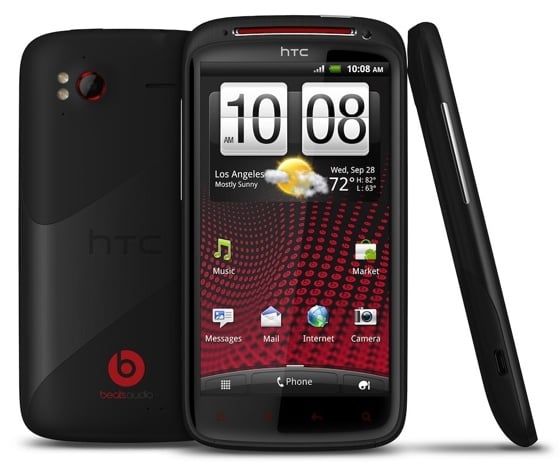
HTC Sensation Beats XE

The epitome of the new Android super-phones, this latest turbo-charged version of HTC’s already impressive Sensation [2] is inbound complete with trick sound processing courtesy of a tie-up with Dr. Dre’s Beats Audio outfit, plus a dual-core CPU running at 1.5GHz rather than the standard Sensation's 1.2 and an extra 210mAh of battery capacity.

Draped over Android is HTC’s ever improving and altogether excellent Sense 3.0 interface, which really does give Android the final degree of visual and tactile polish to make it more satisfying than anything Apple has cooked up to date. As a way of tying your contacts and social network together Sense is without equal.

The serious CPU is matched by a serious screen and though the 4.3in, 540 x 960 LCD panel isn’t quite as glorious to behold as the Samsung Galaxy S II’s OLED display, that’s a bit like saying you’d rather date Beyoncé than Rihanna because she has the slightly better singing voice. You really are going to be happy with either.

Reg Rating 90%
Price TBC
More Info HTC [3]

LG Optimus 2X

While HTC, Sony Ericsson and Motorola have embraced Android like a fat bloke clutching a bag of chips, LG has been rather more conservative in it’s development of both software and hardware. This is reflected in the number of Googlephones it sells and how much media and retail profile they get.

Despite that, the Optimus 2X was the world’s first dual-core processor phone and features-wise it more than holds its own with a 4.0in, 480 x 800 IPS screen, 8Mp and 1.3Mp cameras, 8GB of built-in storage and an HDMI port. With a 1GHz Nvidia Tegra 2 chip, it goes like an outhouse door in a hurricane, and if you look hard you can find one for under £300.

There’s nothing wrong with the design but it’s a little too plain and unadventurous for my taste, and LG’s Android overlay isn’t going to get the crowd in the pub going “ooooh” either. Compared to the competition, the 2X lacks that last bit of magic - and the UK has yet to get the Gingerbread update - making this a handset you will grow to like and respect but probably not love.

Reg Rating 75%
Price £290
More Info LG [4]

Motorola Atrix

With it’s dual-core Tegra 2 chipset and optional-extra netbook-style keyboard docking station [5], the Atrix heralded the dawn of the über-phone - a device designed not just to work as a smartphone but as the engine for a laptop which can act as your principle mobile computing companion. Replace the Lapdock with the remote-control three-USB/HDMI media dock and the Atrix becomes a home media hub.

You’d expect the 4.0in, 560 x 940 display to be crisper than freshly picked lettuce that’s been dipped in liquid nitrogen, but the PenTile RGBW matrix sometimes manages to make text look less smooth than the lower resolution competition. The advantages are reduced power consumption and increased brightness, and boy is it bright.

The Tegra 2 underpinnings give the Atrix some serious performance, helped by 1GB of Ram. You also get 16GB of internal storage, while the impressive but expensive - the Lapdock will set you back in the region of £250 - accessories make it a very versatile device. One word of warning: there is still no sign of the promised 2.2-to-2.3 Android update in the UK.

Reg Rating 80%
Price £349
More Info Motorola [6]

Motorola Pro+

OK, let’s assume you want a good smartphone but with a real keyboard. That could mean exile to BlackbBerry-land. But fear not, while there’s no iOS phone for you there is an Android. Packing in a 3.1in, 640 x 480 touchscreen and a 35-key Qwerty deck, the Pro+ means you can have your input cake and eat it.

While most Android messenger phones are budget gutless wonders, the Pro+ boasts a Texas Instruments OMAP 3620 1GHz CPU with 512MB of Rom and 4GB of storage. In the admittedly limited time I got to play with the Pro+ - the official UK release is still a month or two away - I was very impressed by the keyboard which gives little away to the the best from RIM.

Unlike the first Pro, which never made it to these shores, the Pro+ has dumped Motorola’s unpopular Motoblur launcher in favour of something less resource-hungry and a lot more attractive. The new curvaceous body design is a welcome improvement too. The 1600mAh battery should give a decent time between charges with only 300,000-odd pixels to worry about.

Reg Rating 80%
Price TBC
More Info Motorola [7]

Samsung Galaxy S II

Proving that making a handset in white as well as black actually isn’t all that difficult, Samsung’s Mk. 2 Galaxy S is, depending on whose numbers you read and believe, the best-selling smartphone of 2011, though clearly that's an achievement helped by the iPhone 4 having been released in 2010.

The reason? The 4.3in, 480 x 800 OLED screen, which by general acclamation is the best mobile phone screen known to man or beast. The top-end spec and rather cool 8.5mm profile may have something to do with it too along with Samsung’s Apple-worrying global sales and marketing clout.

Despite the 1.2GHz dual-core CPU, 1GB of Ran and 16GB of storage, I’m slightly put off the S II by Samsung’s TouchWiz launcher, which just doesn’t get my juices flowing. And while the design is very sleek and clean I think it’s also just a bit dull. Given the choice, I’d rather have the HTC Sensation, though the Galaxy S II is still a very, very fine device.

Reg Rating 85%
Price £455
More Info Samsung [8]

Samsung Google Nexus S

If you want to stay at the cutting edge of Android, you need a Nexus - it’s as simple as that. The second phone to carry the hallowed Google name, the Nexus S brings its owners Android updates direct from the horse’s mouth rather than having to wait for a handset maker or telco to get its act together and roll them out.

Though one of the older phones in this line-up, the spec is still more than solid with a cracking 4in, 480 x 800 OLED screen which looks slightly curved though the panel is actually flat. Only the glass it’s glued to curves.

Underneath there is a 1GHz Samsung Hummingbird chip with 512MB of Ram. With no power-draining custom launcher, it goes like the clappers.

Unusually for a ‘droid there’s no Micro SD card slot but with 16GB of internal storage that’s not so much of a problem. You do get a Near Field Communication chip and support for Google’s Wallet e-payment system though unless you live in the US and are using the Sprint network that’s not a lot of use to you at the moment.

Reg Rating 85%
Price £420
More Info Google [9]

Sony Ericsson Experia Arc

Sony Ericsson’s first Android phones were ugly and graceless lumps but its new, second-generation devices are altogether more appealing. Some are actually rather lovely. In fact, Sony Ericsson easily gets my Most Improved Android Maker of 2011 Award and is now the brand I most often recommend.

The origin and exemplar of the new breed is the Arc, a curvaceous and sleek device that makes the iPhone 4 look as dull as ditchwater. The most obvious styling cues on the Arc are the gentle curvature of the back, the near full-width screen and the classy chrome and graphite colour scheme. Taken as a whole it simply oozes visual appeal.

With it’s Bravia-branded picture processing and a 4.2in, 480 x 854 LCD screen, the Arc’s video playback skills match its looks while the 8.1Mp camera has a low-noise digicam-derived sensor so it’s pretty good at taking pictures too. SE’s Android overlay won’t displace HTC’s Sense in my affections but it’s not a bad effort and is both very fluid and easy on the eye.

Reg Rating 85%
Price £420
More Info Sony Ericsson [10]

Sony Ericsson Xperia Play

If you want to play games on your phone, you want an Xperia Play, a hybrid phone and gaming machine from a company that knows a thing or two about mobile gaming and how to get the most out of an inherently compromised form-factor with the minimum of end-user frustration.

The underpinnings may not be anything out of the ordinary. A 1GHz Qualcomm Snapdragon CPU with 512MB of Ram is only par for the course in this company, as is the 4in, 480 x 854 LCD panel. And it really should have an HDMI port. But slide the top and bottom apart and - ta-da! - proper gaming controllers so you can play without your fingers obstructing the view.

Slide the two halves back together again and you have a perfectly usable if rather thick - 16mm, since you ask - phone with all the usual Sony Ericsson refinements. Thankfully, SE has resisted the temptation to emblazon the outside of the device with juvenile gaming iconography but has gone to the effort is installing a truly excellent little speaker.

Reg Rating 80%
Price £420
More Info Sony Ericsson [11]

ZTE Skate

Try to earn a crust by scribbling for Reg Hardware and you soon learn to appreciate a bargain, and that is exactly what the Skate represents. In its re-paid form, it’s better known in the UK as the Orange Monte Carlo, a phone that will set you back a measly £150 plus the obligatory £10 of airtime.

Of course, it can’t hold a candle to the other Androids here in terms of overall performance, but anything with a 4.3in, 480 x 800 screen for this sort of money has to be worth a look. Yes, the innards are a bit gutless - you end up with a Jaguar XJ body but a Hyundai Accent engine. But gaming and video playback aside you don’t actually miss much.

The handset is slim, light and very well made while the speed of the user interface gives little away to phones costing three times as much. Battery life isn’t bad either. For working on Google Docs, social networking, e-mailing, using as a (free) satnav or for a host of other less demanding jobs the Skate will do just fine thank you very much.

Trend: mobile OS wars and the advance of open source

Trend: mobile OS wars and the advance of open source
Title: Everything you need to know about today's apple event
Comment: still in the "me to" phase

Link: http://techcrunch.com/2011/10/04/everything-you-need-to-know-about-todays-apple-event/

It’s been a busy morning in Cupertino at Apple’s ‘Let’s Talk iPhone’ keynote. The big headline was the iPhone 4S, but no iPhone 5. Perhaps you had a hard time following all the news from Apple on the iPhone, iOS 5, other iOS devices and apps. Apple didn’t offer a live online webcast to the public. But the TechCrunch team, on two continents, has been busy tracking all the Apple news. Click on any of the headlines for more info:

The Live Blog

MG Siegler’s Live Blog From London
iPhone 4S

Apple Officially Announces The iPhone 4S: Same Design, All New Insides
The iPhone 4S—It’s What’s On The Inside That Counts
Watch: Here’s Apple’s iPhone 4S Video Intro
The iPhone 4S Camera Upgrade Explained
Apple Announces “Cheaper iPhones: The Old Ones
iOS 5

iOS 5 To Be Available To Everyone On October 12th
Siri – Your Humble Personal Assistant App

Apple Reveals Siri Voice Interface: The “Intelligent Assistant” Only For iPhone 4S
The Original Siri App Gets Pulled From The App Store, Servers Killed
Siri: My “Humble” Female Personal Secretary
Other Apps

Forstall Intros New And Improved iOS Apps: Cards, iMessage, And More
Apple Announces ‘Find My Friends’ — Which Parents Can Use To Track Their Child’s Location
iPod Nano & Touch

iPod Nano Updated With Improved Fitness Features
Apple Drops iPod Touch Prices, Adds iOS 5 And iCloud
The Reaction

“Access Denied”: Apple.com Goes Down Post-iPhone 4S Event
Apple Stock Drops 5 Percent After The iPhone 5 Fails To Appear
TCTV: Is The iPhone 4S A Worthwhile Upgrade?
How The Predictions Fared

Apple iPhone 4S/5 Rumors: What Was Right, Wrong and Just Plain Crazy
Where Was Facebook At The Apple Event Today? Not There. Stay Tuned.
Apple’s Latest Stats

Six Million Copies of OS X Lion Sold, Outpaces Snow Leopard
iTunes Now Has 20M Songs; Over 16B Downloads
Apple Has Sold 300 Million iPods In Ten Years, 45 Million Just Last Year
Tim Cook: 250 Million iOS Devices Sold, Huge Retail Traffic, Record Numbers Everywhere
Tim Cook: 250M iOS devices Sold, The iPad Is The Undisputed Best-Selling Tablet In the World”
More Than 1 Billion iOS Apps Are Downloaded Each Month
Tim Cook: iPhone Has 5% Of Mobile Phone Marketshare Worldwide, “An Enormous Opportunity”

Saturday, October 01, 2011

Trend: The rise of big data
Title: Big data Equals big opportunities for businesses
Comment: Good data is EVERYTHING

Link: http://gigaom.com/cloud/big-data-equals-big-opportunities-for-businesses-infographic/